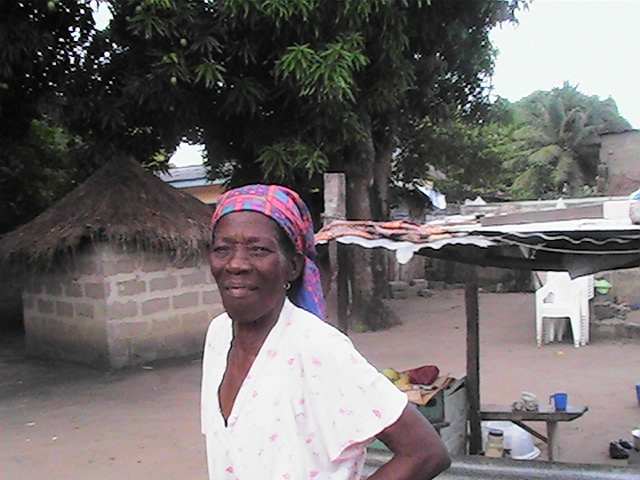
Wednesday, November 07, 2007


Tror Na Foe (troh-nah-fway)
A phrase in Ewe, the ancestral language of my father's ancestors in the southeastern corner of Ghana, meaning roughly "to return and find again."
(photo: children in the park rangers' quarters at Larabanga, Nov. 2007)
I Hold High My Beautiful, Luminous Q'uran, Part III
Here's the third part of my four part story about a graduation party to which I was invited in Ghana's Muslim north. See you next time with the fourth and final installment. Enjoy. And if you are new to the site, I invite you to scroll all the way back to the beginning, so that you can read all about the adventure our family on this side of the Atlantic has been enjoying since finding and making contact last year with the original African family from whom we had been separated by slavery for some two hundred fifty years!
--------------------------------------------------------
Watching [the kids dance] made me think of other kids in other places on earth on this Friday night, eagerly looking, even within the mannered confines of a well-chaperoned dance, for the hot, electric thrill only a little proximity with the opposite sex can give.

From time immemorial, when men and women have partnered up to dance, dance has been a metaphor – a meditation in motion – encompassing every aspect of our relationship with one another: communication, both spoken and unspoken; nurture; longing and desire; sex. The European tradition is full of slow, courtly dances which leave a lot to the imagination. Subtlety is the point. Boys and girls taught to dance in this tradition learn, literally, to turn slow, cautious circles around each other as they take their first baby steps toward deciphering the deeper mysteries of intimacy between men and women. Generations of youth have taken some of their most important and memorable steps toward adulthood as they promenaded awkwardly onto the floor with a partner at a middle school dance, watchful adults in the wings making sure that all major body parts remained a respectable distance apart.

But Africa, the original Land of A Thousand Dances, is the home of the beat that created rhythm and blues, rock and roll, and jazz, and funk. The dances people do to this music are more primal and leave a lot less to the imagination. Some are an exuberant and unapologetic celebration of sex and desire. Just as changing beliefs and understandings about sex in western culture gradually freed love-making from the insanely limiting confines of “the missionary position,” dances eagerly adopted in the West from the Afro-Caribbean-Latin tradition have profoundly energized and underscored a liberated consciousness that there are, indeed, many, many wonderful ways to make whoopee.

Yet even with their evolution into styles which are, at base, a celebration of all things carnal, the dances which have sprung from this tradition have still left at least something to the imagina-tion. But lately, as any adult who’s recently chaperoned a dance will tell you, one popular style, even with the middle school set, is nothing more and nothing less than just raw, simulated sex. No matter where parents find themselves between the extreme right and the extreme left of the culture wars continuum, there is, generally, a feeling that this trend away from at least a thin veneer of subtlety has drifted too far.

So, I was intensely curious about how this concern over what is widely perceived as a coarsening of world youth culture might play out in a rural village where fundamentalist Islam holds sway. How much would these kids care to mimic the styles they see in American and European hip-hop videos? How far would their adult chaperones let them go in a culture which forbids both close dancing and dating as we know it?

It dawned on me, as I strained to hear and understand the lyrics of the music being played that a big part of what made this dancing halal (like saying “kosher”, or theologically acceptable) was the lyrical content of these songs. I speak very little Hausa, and no Gonja, the languages of many of these lyrics, but as I listened, the chorus of my favorite song of the evening so far seemed to be saying, “Whatever I do in this life, I know I’m alright as long as stick to my glorious Q’uran.” I checked this out with one of the new ranger graduates when he passed my way to grab himself another cup of punch.

“Yes, yes, exactly so,” he said. “It says, ‘I know I can never stray too far in life as long as I hold high my beautiful, luminous Q’uran.’” As I surveyed the enthusiastic dancers, many of them were singing, some shouting this chorus. So, that was it. As long as the sentiments being expressed by the music were not only innocent, but positively righteous, and the boys and girls were not dancing together, the dancing could be whatever the kids wanted and needed for it to be. And the style they were into was furious and intense.

As the kids with whom I was sitting and I watched, the competition on the floor between the boys was heating up. The dynamic that revealed itself was that one boy or man would make a move toward the center of the pack and then, all eyes on him, he’d bust his best moves, holding the floor for half a minute before fading on back into the pack.

Some of the boys who’d been holding it down on the floor in this manner began to look at Osama expectantly. He and Latif gave each other a look, and then rose in unison, heading straight for the center of the action.

They were both really, really good… fluid; athletic; artful. But Osama’s odd body type gave him whole other set of tools, and he used them well. What he was doing out there is hard to describe, simply because I’ve never seen a human being move like that. It was urgent; crazy… like what "krunk" strives to be, but isn’t quite. His moves were like a rapid-fire ritual in which his purpose was to remove his own skin, not out of some tragic and bizarre self-loathing, but out of sheer joy – as if he wanted to say, “Hey, y’all ain’t gonna believe what I got inside of here! Now, watch; I’m’a show you. Stand back!” Like that.

As he danced on into the next song, neither he nor Latif faded back into the group to let someone else step up into the center. It didn’t feel like a selfish choice on their part.
It was as if the collective mindset of the entire male group was, “Hey, the competition’s over, and we all know who won; let’s just dance.” And dance on, they did, letting these two bring the energy of the whole group up to a fever pitch while the chorus of the current tune raved on, “Allahu akbar! Allahu akbar!” (God is great), their arms flailing; fists pumping skyward to accentuate the words.

I glanced at the time on my cell phone and frowned. The evening was young yet, but I had to pack and try to get some sleep before rising at 3:00 a.m. to catch that 4 o’clock bus to Tamale. I waded onto the dance floor, gamely shaking my rump, shouting to my new friends that I had to leave.

Night falls early and hard in this part of the world. I stumbled and twisted each ankle more than once as I made my way back down the pitch dark gravel road to my room. I washed; I packed, and then I fell heavily onto my bed. It had been a very good day, and the party had provided a perfect ending. Now, there was a knock on my door. It was my cousin David, saying he’d come wake me at 3:15 if he didn’t see my light on. We wished each other a good night, and I settled in to catch some sleep.

Some other time, in some other place, the insistent thump, thump, thump from up on the hill would probably have felt like a real irritant right about then. In fact, I’m sure I would have been lying there feeling more and more pissed off by the minute. But not tonight. Despite the fact that I desperately needed to catch some sleep, the music just made me smile. I pictured the kids I’d met still at it up there; the DJ expertly plying his trade under that glorious velvet black African sky full of stars.

But instead of lulling me to sleep, those thoughts kept me awake… kept urging me up out of bed and back outside. That jet-black African sky, for instance. “When, ever again,” I was thinking, “Am I going to have a chance to gaze at stars in a sky like this?” I’d noticed on the way back down to the hotel that there was an area by the side of the road almost completely free of the little bit of light pollution thrown up by the hotel and the rangers’ living quarters. In fact, gazing up at the glory of it as I walked back down was at least half the reason for my twisted ankles. That thought alone got me half way out of bed. But the clincher came only moments later, when, faintly, behind the sound of the music from up on the hill, I could hear the muezzin’s call for evening prayers from the mosques of Larabanga. Soon, the music came to a dead halt; there were a few announce-ments over the p.a. system… then silence, except for the final chorus of the call to prayer.

O.K., that’s it, I thought. Party over. And now, the call to prayer will be my lullaby, and I’ll get some sleep. Perfect. But within what seemed a span of just a few minutes, I heard the party music start back up again. And this time, it was different. Faster; harder. An Afrobeat/
Techno/Rave thing going on. “Now, this is interesting,” I thought. If most of the adults and some of the youth had all gone down to the mosque to pray, leaving only the die-hard dancers and the DJ up there, what were they into now? Had some of the dynamics on the dance floor changed now that things might be a little looser? Would boys and girls dare to dance together with their chaperones gone? I had to know. If it meant getting through the next hard day’s journey on even less sleep now, or perhaps no sleep at all, I was curious enough to risk it.
------------------------------------------------------------------------------------------
I'll have the conclusion of this story for you next time. See you then.

Monday, September 17, 2007


(Troh-na-fway) in the Ewe language spoken by my father's ancestors in Ghana, Togo and Benin, means "to return and find again."


(photo: The chief Imam of the ancient mosque at Larabanga)


Here, folks, is part 3 of a story about a party I got to attend in a village in Ghana's Muslim north while exploring the country with one of my new-found African cousins this past November. If you follow this blog, you know that nine family members from this side of the Atlantic made the trip together just last month. Look for video and photos from that trip soon. Meanwhile, please enjoy this installment of the continuing story...

I Hold High My Beautiful, Luminous Q'uran

When the announced start time of 6:30 rolled around, David and I were the first guests to arrive… the only guests for a while. We watched as a couple of local women turned up, matronly, but like butterflies in their brightly colored, party best. As they got the punch bowl and some refreshments arranged on a side table, the DJ set up his turntables and his soundboard, fiddling endlessly with the mix on the microphones that would soon be used for speeches. He started messing around with the speaker mix for the music, and the four nervous ranger graduates got up to shake off their growing anxiety about having to speak and be the center of attention by dancing with one another – tentatively at first, but then with more energy. Soon, a few kids from the rangers’ quarters turned up and began to dance too, around the edges of the outdoor employees’ canteen where the festivities were being held. Before long, they were joined by a growing number of kids who came by bike, on foot and by motorbike from the nearby town of Larabanga, and other smaller villages a little farther up the road.

But still, things were a little disorganized, and it became clear to us that nothing was really going to happen for a while. Quite hungry now, David and I decided to take advantage of this lull in the action to wander back down to the hotel for some dinner.

When we sauntered back up, our bellies full after a pretty good meal, the party was finally in full swing. A couple of young European back packers had wandered up there, but, even after repeated entreaties over the p.a. system that were easily heard downhill at the hotel, David and I were the only other guests who came.

The four graduates received their diplomas, to much applause, and then the music, which had otherwise been blaring constantly, was cranked back up. But this time, it was serious. The obligatory speeches and ceremony were done, and now, it was time to dance.

David excused himself, reminding me not to stay too long because we had to get up well before the sun to catch a 4 a.m. bus into Tamale the next morning. I said I’d be along soon, but I’d been anxious to hear some more of this music, and now, here it was.

The dancing, which had until this moment been confined, except for the graduates, to the outside perimeter of the open-air canteen area, now slowly took over the entire space.
Anyone who’s ever been to Africa will tell you, there’s no such thing as a wallflower at a party. Even non-dancers with their amateur anthropologist hats on like me will eventually have to get up and dance. In my case, it was young Latif who called me out. He’d seen me smiling at him and some of the other youth as they warmed up to take the floor, and they’d been curious about where I was from. After I gave them a good laugh with my spirited but Cosby-esque gyrations on the floor, we talked – shouted at each other – over the booming, compelling sounds of the pop music of their native land.

It was a big deal to them that I was from the U.S. Huge. When they asked me about my work and I told them I’m a writer, mostly a screenwriter and playwright, they got really pumped. Now, the excited, rapid-fire inquiries were all about who I know. “Damn,” they were thinking, “Brotherman must know all kinds of incredible people we’ve heard of.” I hemmed and hawed… and it hurt me to watch creeping disappointment suddenly dull the bright, expectant sparkle that had lit up all their faces just moments before. I was losing major cool points by the millisecond. I rattled off a few people they might know, before the well ran pretty dry, and I had to dig deep for stories from friends and associates who have at least been in the same room with some of the people they’ve heard of. This did the trick. Very quickly, joy returned because, just like that, the huge space between them and the epicenter of all things cool had shrunk considerably, and they were basking in the glow of how it suddenly felt to be a mere two degrees of separation from Tupac, Snoop, Jay-Z, J-Lo and Oprah.

As my official host, my new friend Latif had just scored major cool points too, and I could see it in his eyes as he drank in their admiration – especially the awed expressions of the girls on the periphery of the action here. An already pretty good party was suddenly much more full of intriguing possibilities for him. He spoke mostly in rapid fire Gonja, but the sense of it was easy enough to understand. “See, I told you he was cool,” he was saying.

And as I scanned their beautiful, sparkling faces, it hit me like a ton of bricks – about a third or more of the people gathered there were female, but so far… between the graduates; the emcee, the DJ; the dancers – it had been an all-male show. The grown women had been in the background applauding the speeches, serving food; watching the kids. But in the dark fringes of this outdoor cafĂ© turned party room, they had literally become invisible now. And the girls – all in hijab; all in colorful party clothes – they’d hung together in a pack, in their own space out on the edge of things, their eyes on the boys they knew, watching their moves; tittering back and forth with each other about them like birds on a wire.

Suddenly, my eye caught something else that turned my attention entirely away from them. Into the party walked a lanky youth whose t-shirt sported a very familiar face.

Back in Accra, I’d seen several sidewalk stalls that press images onto plain white “Ts” for you. It seemed to be the same basic choices everywhere. You could get white Jesus, brown Jesus, Nelson Mandela, Bob Marley or, interestingly, Osama Bin Laden. I’d been thinking, if I had a spur of the moment opportunity, that I’d buy that brown Jesus. No lame, schlocky t-shirt Jesus, he, with his deep, beautiful eyes. And he wasn’t merely the white Jesus, but tinted brown, either. He had his own face; his own impressively deep persona. So… brown Jesus, Nelson Mandela and Bob Marley, I was thinking. One of them for me, and the others for gifts. I’d had yet to actually see anybody sporting one of these shirts, so ubiquitous at the street stalls. But now here came Osama, big as life, rippling like a limp flag on the chest of this gangly, dust-covered kid from the village.

Before he could advance even a few steps from the entryway, Latif shot like a bolt to his side and pushed him up against the fence. I was alarmed. I stood up to see what was going on back there where almost no light managed to seep over from the dance floor and the area around the refreshment table. But it didn’t feel like a fight. Nobody back there seemed to feel it was necessary to separate them. All I knew for sure was that Latif was speaking to him very urgently about something, then gesturing back towards me. And then I watched Osama remove his shirt, turn it inside out, and put it back on. Latif seemed satisfied and returned to the area near where I’d been sitting. Now I understood. Latif was looking out for me. He hadn’t wanted me to feel offended by the sight of a local kid sporting a Bin Laden t-shirt.

I caught Osama’s eye and called him over. Now, in the light, I could see something that I’d only caught a tiny glimmer of when I’d first spotted him in the near darkness of the entryway. It was the way he moved. It wasn’t just the awkward gangliness of an adolescent who hasn’t quite grown into his suddenly larger frame yet. He seemed to me now an oddity of nature – someone whose every joint is not merely double, but entirely elastic – a rubber man. As he approached, I smiled broadly at him. “Hey, kid, your t-shirt’s on inside out. That the new style or something?” He grinned sheepishly and looked down at his feet. “I saw you have Osama on your shirt.” He looked confused. “Osama… Bin Laden. I saw you have his picture on your shirt.” Latif spit some terse words at him in Gonja. “Oh,” said Osama. “The shirt. You saw.”

“Yeah. I saw. You a big Bin Laden fan?”

Osama shrugged. “He fight for Islam.”

“Hmmm. Well, there’s all kinds of ways to stand up for your faith without killing folks, don’t you think?”

He nodded slowly, his eyes never rising to meet mine.

“You like to dance, huh?”

Suddenly, for the first time, he gave me his eyes, and they sparkled. “That’s why I’m here.”

“Well, don’t you know, if Bin Laden ran this town, y’all wouldn’t be holding this party tonight? Would’ve been some speeches, and a lot more praying. But no music… and no dancing.”

He looked a little sheepish and shrugged. I got it. I wasn’t going to break this kid’s balls over his damned t-shirt. It occurred to me that for kids in this part of the world, wearing a portrait of Bin Laden on your chest might mean you want the world to know he’s your personal hero, but I’d bet my last dollar that for most, it’s probably much more about wearing a big “F.U.” on your chest… a way, like anywhere else on earth, for a kid to wave the flag of rebel youth in the face of every adult who crosses his path, the point being to offend or piss off as many people as possible. Osama was no heavily-politicized young jihadi. He was just a kid who likes to dance, looking for a little action on a Friday night in a place where there’s generally little action to be found.

“Let’s see your moves then,” I said. “Let’s see what you’re all about.”

He cracked a wry grin. “Let’s see yours first.”

“I already did mine,” I said. “You missed it.”

Latif backed me up. “He was funny.”

The DJ was into a furious mix now; wonderful stuff; and the crowd was eating it up, girls in their corner and the guys in theirs - parallel universes – a guys’ party and a girls’ party, sharing the same space, but, at least on the surface, only tentatively connected to and aware of each other. Yet all were dancing, on fire, to the same relentless, throbbing beat.

Wednesday, August 29, 2007


Tror Na Foe (troh-nah-fway)
A phrase in Ewe, the language of my Ghanaian forbears, meaning, roughly, "to return and find again."
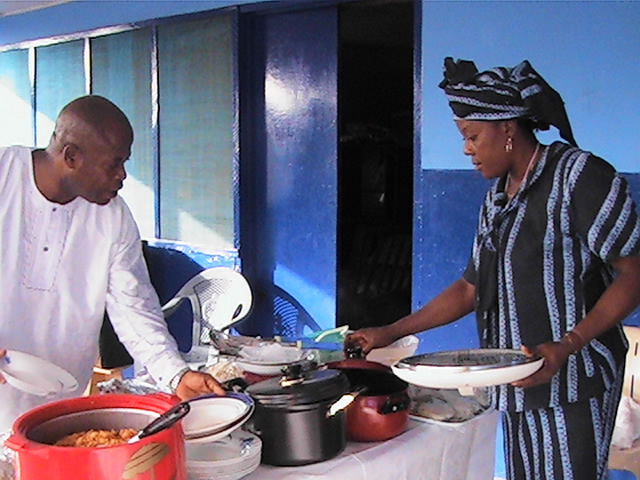
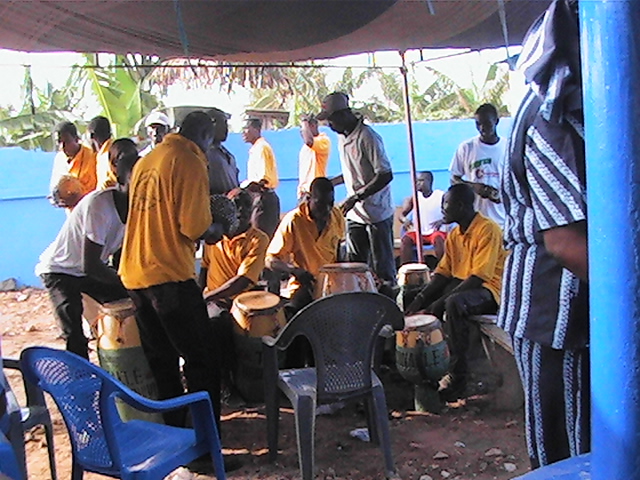
(Photo: Main entrance to the fabled mosque at Larabanga, reputed to be the oldest in west Africa)
If you come back here from time to time to see if I've added anything new, thanks very much for your loyalty and your interest. It's been hard to devote much time to the blog, since making a living at the kind of writing I do means spending an awful lot of time working on projects that help put bread on the table or hustling new work. I'm trying to step up my game and be much more regular again about posting. If you are brand new to this site, welcome! I invite you to scroll all the way back to the beginning and work your way forward.
My family and I have just returned from a glorious two weeks in Ghana together - nine of us! Look for details of this momentous trip in the coming weeks. The photo above was taken in Larabanga, at the legendary mosque for which the town is known. We all agreed it is one of the most beautiful buildings we have ever seen. And it's very relevant to the continuation of the taveler's tale I began sharing with you last time in part one of "I Hold High My Beautiful, Luminous Q'uran." Here now is part two. See you again soon.
--------------------------------------------------------------------------------
"I Hold High My Beautiful, Luminous Q'uran" part two
Heading north from Kumasi, it didn’t take long before we saw the landscape begin to change from the lush green farm land and forest of the central region to semi-arid scrub brush and savannah. Small towns with modest houses of painted concrete gave way to tiny villages with conical houses of mud, wattle and thatch. A landscape liberally dotted with churches of every conceivable denomination; stores and produce stands named in the classic Ghanaian style: “Why Can’t I Just Thank My Jesus Grocery;” “God is Able Beauty Salon;” gave way now to mosques, and to stores and stands named, “Insh’Allah Blade Sharpening” and “Allahu Akbar Small Electronics Repair, Computer Training Institute and Internet Cafe.”

As we neared the center of dusty Tamale, I noticed that there was nowhere near as much new construction going on here as I’d seen in the rest of Ghana … but out of the three nearly-finished buildings I’d seen thus far, two were mosques. We neared the STC bus station and suddenly, the call to evening prayer erupted from a dozen minarets; some only steps away from our bus; some from distances too far to see. The same words, but sung/recited in different keys by a diverse set of voices, overlapping; slightly out of synch with one another: “Ashadu la illaha il’Allah.” And yet, far from dischordant, the rising crescendo of this chorus - “Wa Muhammadu Rasul il’llah” – created a compellingly beautiful music that seemed to rise, like the red dust lifted by the Harmattan wind all around us, from the earth itself. Some passersby outside our windows dutifully scurried along toward the nearest mosque; others went about their business, anxious like all of us passengers on the bus, to get to their destination before evening could finish painting the dark blue sky of dusk to velvet black.

As David and I alighted from the bus, we knew we didn’t have long to procure ourselves some reliable transport out to the park. We’d heard that Mole, even though only about 85 kilometers distant, was not an easy journey from here. The way there was all over very bad road, and it might take as long as four hours of rough travel to reach it. And we knew we’d already missed the only bus of the day that goes all the way. When we started asking cab drivers how much they’d charge to take us, some balked because of the condition of the road; others quoted us prices that were insane.

Frustrated, we went in search of a tourist bureau I’d read about in a guide book. But even if we found it, would it still be open at this late hour? Suddenly, a voice called David’s name from a nearby market stall. It was Mary, a distant relation from the old village. Up in this Dagomba and Gonja-speaking region, it was like music to David’s ears to hear someone warmly and familiarly address him in Ewe. After introducing me, and explaining our situation to Mary, she quickly made it clear we were in very good hands. Her husband, John, also an Ewe from the Volta region, is the accountant and de-facto station manager. She led us across the STC station to his office. After a brief strategy session, John and David decided it would be best to stash me out of sight behind the counter at Mary’s stall – too obviously a foreign tourist with my relatively nice luggage and my camera case – while they negotiated with a couple of drivers who owed John a favor or two. I chatted with Mary and her assistant, and bought bottled water for David and I while I waited.

After a couple of minutes, they returned with a surly driver who’d been talked into a price he wasn’t happy with. He had a very dubious looking cab, too. I couldn’t imagine this rust bucket, barely held together with spit, rubber bands and paper clips, had even one more 170 mile round trip in it, much less 170 hard miles. After only two weeks, I’d already traveled in far better looking cabs that broke down after just a few miles of challenging road. But I needn’t have worried. This driver and this car were true road warriors in the best west African tradition, and four hours later, we arrived. We’d been shaken as though tossed into a blender and whizzed for a while, and we were covered from head to toe in fine, red dust… and the hour was late. But we were there. I saluted and hugged both the car and the driver, and gave them the fattest tip I could manage, saving out just enough for the bus trip back to Tamale.

The hotel is nice; clean, sunny rooms, but no frills, and the water is only on for a few hours each day. But it’s safe to drink. And there’s a pool. And a decent restaurant with a bar. And just down from the pool, there’s an observation deck, perched in a perfect position for guests to sit and watch the action at the two watering holes on the wild, species-rich savannah below the escarpment on which the hotel sits.

That next morning, just after sunrise, David and I enjoyed a three hour hike with park ranger John, and a very pleasant retired German couple enjoying their second holiday of the year. Our “safari” didn’t disappoint. We saw herds of two different species of antelope; several species of birds; elephants and crocodiles. And later in the day, at very close quarters, we saw dozens of baboons, warthogs, and collubus monkeys. Great stuff. I shot a lot of photos and video.

But the most memorable part of our stay happened during the night hours, when all kinds of activity is going on in the park, invisible to all but those who have a great, hidden perch and night vision glasses. David and I lamented the fact that we didn’t have these. But fortunately for us, these are not necessary for night people watching.

Early that evening, a staff person made the announcement that at 6:30, there’d be a graduation ceremony just up the hill in the park rangers’ quarters for several new rangers, and that any guests who wanted to come were very welcome. As soon as we heard, David and I knew we were going. We wanted to support the new rangers, just out of principle. In a region where few good jobs are available, these are good jobs. And local guys like these new graduates are precisely the ones who have the best chance at convincing old friends, family and neighbors not to poach on park grounds; to participate in making this area safer for all the endangered animals and more tourist-friendly at the same time.

I had another reason for wanting to come. The music of this region has always spoken to me in a special way. My cd collection at home is full of the Islamic-flavored music of the sahel: Salif Keita, Thione Seck, Ba Cissoko, Oumou Sangare, Ali Farka Toure, Sekouba Bambino, and Issa Bagayoyo, among others. Wandering through the rangers’ quarters that afternoon, I’d heard intriguing bits and pieces of northern pop music in the air: the music kids were dancing to while they played, blaring from radios their mothers had placed in windows so they could listen while hanging laundry; wafting out from kitchen doorways while they began work on the evening meal. It was wonderful – melodic; complex; flute and voice driven, with rolling base lines and undulating percussion underneath, and I wanted to hear more. And since every African party is a dance party, I was pretty sure that tonight, at the graduation, I’d get my wish.
-------------------------------------------------------------------------------------------
Next time, part three. See you again soon.

Monday, August 06, 2007

Tror Na Foe

(Roughly, "to return and find again" in Ewe , the language spoken by my ancestors on my father's side).

This blog documents the story of how, through DNA-based genealogical research, we have found and connected with the original African family from whom my father's line had been separated by the trans-Atlantic slave trade. I invite you to scroll back through the earlier installments to pick up the story from the beginning. I've been working on a book about this whole adventure, but as I write this now, I'm switching gears a little and preparing to get the rest of my family on this side of the Atlantic in on the excitement too. On Friday of this week, nine of us are headed to Ghana together!

I don't have time now to share details of everything that has transpired with the continued development of ADFaR (African Diaspora Family Reunion) but I promise I will shortly after our return from Ghana at month's end. Meanwhile, I thought I'd share with you a story I wrote for the travel magazine trade shortly after my return from that first trip to Ghana in November. It's LONG... so I've broken it up into installments. May it help in some small way to build bridges to the Muslim community, in Africa and elsewhere.

--------------------------------------------------------------------------------
I Hold High My Beautiful, Luminous Q’uran

How do kids in a rural, West African Muslim village manage to “get krunk” with each other on a Friday night in a culture that doesn’t allow dating, or even holding hands?

In mid-November, 2006, my cousin David Agbemabiese and I visited Ghana’s Mole National Park. My agenda for this first trip to Ghana had been unbelievably rich and deep, so this expedition up to a game preserve in the savannah of the far, Muslim north had been only tentatively penciled in… something I’d try to pull off if it didn’t interfere with my primary business. I was here in Ghana because, through DNA-based geneaolog-ical research, I had just recently found and connected with the African family from whom my father’s line had been separated since slavery – a very big deal, indeed. And I had just dived head first into the writing of both a weekly blog and a book about the experience.

I had found a large group of blood relatives here in Ghana, separated from my family in the U.S. by an ocean and about three hundred years of history. And they were anxious to meet me and see, if after all this time and distance, there was anything at all about us that might still make us identifiable to one another as family. We had discovered to our surprise, joy and delight, that yes, indeed, there was. Incredibly, strong physical resemblances had survived; shared interests; attitudes; a dozen different little recognizable traits of family character. Amazing. And there was so much family to meet. Patriarch John Kofi Agbemabiese had, over his long, successful and highly interesting time on earth, sired forty-one children with seven wives. I spent a couple of very intense weeks being escorted around the ancestral Volta region, Accra, and Kumasi, getting introduced by one group of relatives to another. In between, I stole time to write, and occasionally, to be a tourist too.

My cousin David, who squired me around Kumasi to meet relatives and to see the town, had recently lost his job. When another relative told him of my desire to visit Mole Park, he’d jumped at the chance to accompany me. I was paying, and he had the time. “We don’t do enough internal travel,” he said. “We have so much beauty here, but we Ghanaians, we hardly ever get the chance to see and enjoy our own country.” Travel in west Africa - even in a country like Ghana with much better than average infrastructure – is hard. And it’s not cheap, in a society where the economy just limps along and almost everyone is chronically underpaid.

Mole had held a special allure for me, ever since I first read about it in the process of preparing for this trip. I’d loved every minute of my time on the coast, the hill country; the rain forest. But so much of the long-imagined Africa I’d kept in my head and heart had always been about the savannah too - the land of baobab trees, mud houses and mud mosques; the sahel region at the edge of the great Sahara – the home of magical, mythical towns like Timbuktu and Djenne. And the other savannah; the home of big game and the safari. Mole has developed a reputation among travelers of being one of the only places in all of west Africa where visitors can have that quintessential east African experience of close encounters with some of the big, endangered animals with which Africa is forever linked in the popular imagination. And this is a place where you don’t need to rent a guide and an expensive four-wheel drive vehicle to see the park and its animal life. At Mole, you get to do your safari as part of a small group led by a ranger, on foot. You can also explore the park’s miles of trails by rented bike. A sure ‘nuff wild-animal-spotting safari, but free from the stereotypical, “great white hunter” echoes of the colonialist past? The prospect was much too good to resist.

The burly, charismatic driver hopped onto our bus at the Kumasi STC station like a performer taking the stage. “As Salaam aleikum,” he shouted. The two-thirds of the passengers who were northerners going home – and some of the rest of us too – shouted back “Wa aleikum, salaam,” as he launched into his good-natured apology on behalf of the STC that this vehicle on which we’d be spending the next nine hours or so was second class, not the first class bus we were supposed to have. But, no worries, said Wesley, after he introduced himself with a flourish. We should settle back and enjoy the trip, because, “That first-class bus was crap anyway. This bus, my bus, she’s the queen. I’m telling you, you don’t know how lucky you are to be on this bus. And me, I’m the best driver they got, too.” He flashed a huge grin. “Some of you know me well. They’ll tell you.” And sure enough, some of his regulars laughed and nodded at the rest of us. “You see; you see? It’s gonna be a good ride. Oh, yes! Schmoooo-ve, man, I’m telling you! No troubles; no worries. If you’re ready, I’m ready. Let’s go, let’s go, let’s go!!” He cranked the engine and gunned it extra hard just for show. Well, at least, I thought, there should be no worries whatsoever about this guy falling asleep at the wheel. Not a single goat or chicken between here and Tamale was likely to end up as road kill on this man’s watch. And Wesley promised to be entertainment enough that we wouldn’t for one minute miss the bad Nigerian movies they show in first class.

So, David and I settled in for the ride. My only anxiety now was that cousin Lawrencia, who runs a school in Kumasi, had promised to see us off, and she wasn’t here yet. She is a woman of her word, and I hated the thought that, driven by this powerful sense of family duty she’s got, she was fighting the unbearable Kumasi traffic to get to us, knowing that by the time she arrived at the STC station, she almost certainly would miss us anyway. She’d have to turn right around and fight that traffic going the other direction, with only the slimmest chance of making it to school in time to unlock the doors. I never did see her… but just as the bus pulled out of the station, I heard David call my name from the back of the bus (our seats were supposed to be together, but the ticket agent had messed it up). Slowly, but surely, a plastic bag snaked its way from passenger to passenger until it reached my hand. “Lawrencia,” David shouted. It was a breakfast sandwich of scrambled egg and vegetables, one of two she’d lovingly made for us in the pre-dawn darkness while she fed her husband and kids and got ready for school. Then she’d made the mad dash to the bus station, spotted David in the window, and managed to hand them up to him as the bus pulled away. Miraculously, my sandwich was still warm. After being up since before dawn myself to catch this early bus, I was suddenly very hungry too. I don’t know when I’ve appreciated a meal more.
------------------------------------------------------------
That's all for now. Watch for Part II in a couple of days!

Sunday, December 03, 2006

Tror Na Foe (troh-nah-fway) - a phrase in Ewe, the language of my father's ancestors from the southeastern portion of Ghana's Volta region. Roughly, it means "to return and find again".


photo : a girl and her mother prepare to take center stage during a break in their tradtional Ewe dance troupe's performance in Anloga at the Hogbetsotso Festival, November, 2006.


Note: Once again, I extend a warm welcome to all those readers who may be new to this site. If you are one of these, I invite you to settle back and spend a little time catching up with where we are now by scrolling all the way down to the first installment and reading your way back up. If you don't have time right now, I'm glad you've joined us anyway - just know that this is entry number 8 in a story that has been unfolding since earlier this year, and eventually, you might want to go back to the first few installments to see where and how it all began. Welcome!


Settling Back In... For A While
After an enjoyable and mostly relaxing Thanksgiving week-end, I slowed down my pace even more for a couple of days, just to finish recovering from jet lag. As I write this, I have to admit I'm still not completely recovered. But I can feel myself bouncing back... and not a minute too soon! The holidays are here, with all the hustle and bustle that entails.

I may not be as regular with the blog as I have been until we arrive at the new year, but rest assured, I'll still be posting new installments, so do keep checking in. The number of days from now until Christmas is quickly slipping away, and like many of you, I've got to take some time now to deal with preparations for the season. And suddenly, there's more to do this year than usual. This recent trip to Ghana and the gift of all this new-found family means our Christmas card list just grew by about 40%!

Although it's great to be back in my own house and in the company again of the family, friends and neighbors I've missed, the truth is, I can't wait to get back to Ghana again. I may get the chance as soon as late February, just in time for Ghana's fiftieth independence day on March 6th!

Parsing Out The Story of That First Ancestor
When my wife Celeste and I had our first meeting with Lawrence Agbemabiese, the cousin with whom I made that preliminary contact, before he said almost anything else, he apologized for slavery. It clearly wasn't something he'd planned to say. Our first meeting was an emotional moment, and I think, suddenly face to face with a long-missing relative whose ancestors had been victimized by the slave trade, the enormity of the realization that some of his ancestors may well have been involved in these crimes hit him right between the eyes.


"They had no idea what they were selling people into, you know," he said. "The slavery then practiced in Africa had a completely different character. It was devoid of any idea of racial inferiority, of course. Or permanence... the idea that once a slave, not only were you a slave for life, but your children too, and their children."

The next time we talked, the conversation kept coming back to two things: 1) what a wonderful, unexpected and near-miraculous thing it was to hear from a long-missing African American relative out of the blue; 2) how strange it is that a member of their family of heriditary chiefs could have ended up being taken as a slave. The unspoken subtext of this conversation could be summarized as, "People from our social strata didn't often get sold; we were the ones who did the selling!" That's a touchy and awkward place from which to begin developing a relationship and unraveling a complex family history... but it wasn't for nothing that slavery was called, "the peculiar institution!"

Right before I left Ghana, Lawrence and I had a lengthy conversation on the phone about what our next steps should be, in terms of striving to reach that much longed-for "Kunte Kinte moment" that will identify for us who that first African ancestor of mine was, and unravel the story of how he came to be a slave.

Our new-found Ghanaian relatives told us that during the latter chapters of the dark days of slavery, many Ewe were, indeed, heavily involved in both slave trading and gun running, cozying up, when it seemed most expedient to their survival, to either their neighbors, the powerful Ashanti empire, or to the British. We had read some of that history too. But we had also learned that earlier on, from the mid 1600's until the mid-1700's, many, many Ewe were taken as slaves.


In addition, I knew from the family lore of my English ancestors in Virginia that they had started buying slaves in the 1660's. And it just so happens that the 1660's were a catastrophic decade for the Anlo-Ewe people - the beginning of a period that saw many of them sold away to the New World. There were costly wars with their Ga neighbors, among others, to the west, as well as with the kingdom of Dahomey and the Oyo empire to the east.


The decision to engage in warfare was a very difficult and weighty matter for the Anlo-Ewe. There was, on the one hand, an ancient and proud warrior tradition, balanced on the other by a powerful belief in the sacredness of human life. That belief is so strong that the Ewe also have an ancient tradition the militaries of the world would do well to study and copy today. After a war was concluded, all veterans were required to move together into a special encampment - a soldiers' village - that was maintained for the exclusive purpose of helping soldiers "decompress" and heal from the stresses and horrors of battle for a time before they were allowed to return to their families and normal life.


The core idea was that being forced into a situation in which one had to break the ultimate taboo - the taking of human life - was so devastating to his immortal soul that he needed to be in a setting where he and the others with whom he had marched in battle could now be prayed over together, and forgiven, as well as publicly thanked for their sacrifice. One has to wonder how much emotional and spiritual suffering might be avoided among veterans and their families around the world if such comprehensive "re-entry" programs existed elsewhere(not to mention such a powerful reluctance to engage in war in the first place)!


Given this aversion to killing, whenever faced with the expansionist drive of aggressive neighbors, the Anlo-Ewe had always preferred the passive path of migration to meeting fire with fire, but by the early 1600's - just in time for the slave trade to start heating up - they found themselves with their backs to the sea; one set of powerful enemies to the east; another to the west. The military leaders who stepped up to the challenge received the full support of the people, and before long, the Anlo-Ewe had pushed back their enemies from the Ga country, Dahomey and Oyo, firming up their hold on the territory east of the Volta River that is still the heart of their homeland today.

Fighting back and winning felt good. And within a very short time, the clans which produced the generals and the chiefs who had carried the day against their enemies became the most powerful and prominent families in the culture. With their rise to prominence, worship of their patron deity, the god of war, began to supplant the ancient worship of the matriarchal deities who had ensured good crops and a blessed home life.


Within a generation, those who remained faithful to the old ways of worship - and to folkways that were more matriarchal than patriarchal - began to suffer oppression at the hands of the leaders of the new order. So now, here comes the question my Ghanaian family and I need to ask. Is this social turmoil, commencing in 1668, the root cause of the chain of events that led to my ancestor being shipped away in chains? Was he a member of the Yewe cult, which championed the old ways, publicly challenging and resisting the new, martial culture? Were prominent cult members sold off as slaves, to serve public notice that dissent would not be tolerated?


Anlo-Ewe culture has kept alive many songs and stories commemorating some of the horrors that occured during the centuries of the slave trade. We haven't found a song or a story that mentions my ancestor yet. But this doesn't mean that one doesn't exist. One of my earlier posts on this blog, filed from Ghana, relates the details of that special day on the 4th of November when clan elders read out for me the known history of our clan, the Tovie. But the list of "begats", as far as we can tell now, doesn't begin until around 1750 - about 50 years too late to include the ancestor we're searching for. The answer may lie, however, with some of the contemporary elders of the Yewe cult. Their oral record, their songs, may hold the key to the largely unsung history of their repression and survival... as well as the key to the fate of some of those who were martyred, one way or the other.


My next trip to Ghana, which I hope will be soon, will include at least a couple of visits to Yewe elders who may be able to help us shed some light on this critical question. Whatever we find will be faithfully reported right here at "Tror Na Foe."


Another "Next Step: The Advent of ADFaR (African Diaspora Family Reunion)
Good work has been done in west Africa by Dr. Kittles and others but, given the limitations placed on that work by funding, the geneaological sampling that's been done has been carried out on diverse groups of people. The end result is that someone of African descent here in the North or South American diaspora might be able to identify an ethnicity and/or a region that has a high probability of being the point of origin for at least one family line. But as anyone who knows who has looked at the statistics regarding who's part of the large and growing database at "Y-Search" or "Mito-Search," the number of individual Africans and people of African descent who have participated so far is very small. Tiny.

While I was in Ghana last month, Gideon and I did a lot of talking about what a great thing it could be if more individual west Africans were to be sampled and have their results uploaded into a database. Our discussions are still very preliminary, and the project idea is extremely ambitious. After all, at a ballpark price of $100 per test, it would cost $1,000,000 just to get 10,000 people tested! But we are determined to help this idea grow. Stay tuned! We have already met with Ghana's Minister of Health to "pitch" this idea, and we had a great interview on JOY 97, Ghana's most listened-to radio station. People see clearly how such a thing would be a "win/win" for Ghanaians and African Americans both. We're going to keep on pushing this idea, and we'll be letting you know how it goes... as well as how you can help!


An Appeal for Sky Limit School


Once again, I remind readers that Cousin Lawrencia Agbenyefia runs a primary school near Kumasi (see photo above). I carried some supplies to her in November, but you know how restrictive the airline luggage allowances are these days. So, I'd like to enlist your aid on her (and the childrens') behalf. They need math and science texts and workbooks, appropriate for the early elementary grades; educational games, toys and puzzles; age appropriate books for the library; computer CDs and DVDs; etc. Lightly used items will be fine, but brand new is ideal. If you can help, you may send items or checks to her in care of her church at:


Mrs. Lawrencia Agbenyefia

Deeper Christian Life Ministry
P.O. Box 539
Obuasi, Ashanti Region,
Ghana

Many thanks! See you next week!!

Monday, November 27, 2006

Tror Na Foe (troh-nah-fway) is a phrase in Ewe, the language spoken by my father's forbears, who lived in Togo and the southeastern tip of Ghana. It means, roughly, to return and retrieve something which one has lost.

photo:A little girl and her mother take center stage among a group of Ewe traditional dancers at this year's Hogbetsotso Festival in Anloga.

Heritage
(excerpt from Countee Cullen's poem)

What is Africa to me:

Copper sun or scarlet sea,

Jungle star or jungle track,

Strong bronzed men, or regal black

Women from whose loins I sprang

When the birds of Eden sang?

One three centuries removed

From the scenes his fathers loved,
Spicy grove, cinnamon tree,
What is Africa to me?

Note: We've had many new readers join us these last few days. If you are one of these, welcome! I invite you to scroll down to the bottom of these posts (seven of them now) and read from the beginning, just to understand where we are now in this journey of self-discovery, sparked by the DNA-based geneaological detective work which has made the journey possible.


Identity
I sat at my cousin Happy's house, sipping a tall glass of cool water in her very pleasant, middle-class home, chatting with her husband, Victor, about African American perspectives on Africa. "So, honestly, what do you think of Ghana so far?" he asked. I said nice things, but their little sideways glances at each other made it clear they thought I was being too nice; too easily glossing over the every day issues - some little; some not so little - that wear Ghana's citizens down: an economy improving just enough to inspire frustrated expectations; power blackouts; mile after mile of streetlights that don't work; a national rail system that no longer works. Lots and lots of things that don't work, or which work poorly, at best. "I've been to America twice," he said, "And I must say, although I know you have your problems, it seemed like God's own country to me over there. Your climate makes people energetic; everything works... at least as far as I could see. And you see how things are with us over here. So, I'm always a little bemused about it when I see African Americans here in Africa with stars in their eyes, you know, looking to move 'back home'. I suppose, really, at bottom, it's an emotional thing, isn't it?"

"Yes," I said. "That's exactly it. Something extremely precious and important was taken from us, and many of us have a real sense of mission about taking it back, you know... a specific ethnic and national identity. You're Ghanaian, and you're Ewe. Your language; your culture; your sense of shared history with each other is rich and deep. You've lived it and breathed it all your life. You've been able to just take it for granted. And even though this is an impossible question for you to really answer, I'm going to ask it anyway: can you imagine what your life might be like if you'd never had any of that self-knowledge?" He looked me soberly in the eye and shook his head. "Listen," I said, "I get it when Africans here tell me, 'Man, you'd better appreciate what you have back there in the States. People never understand how precious political and social stability are until they lose them'. "And there are all kinds of material blessings many of us enjoy that the rest of the world envies. I know that too," I told him. But there are many human wants and needs that material things can never satisfy.

Later that night, another Ghanaian asked me about this issue of identity, and I told him of a newspaper story I once read about a young man from Atlanta whose father was African American and whose mother was native Hawaiian. He was raised by his dad in an all-black, east side Atlanta housing project. He'd always been accepted by his community as black, but many outsiders looked at his reddish-brown skin; his wavy hair; his nose; his eyes; and thought he must be Latino... or maybe partly Asian. He never worried much about what others thought, and he never had much curiosity about the Polynesian/Hawaiian half of his heritage... until the summer he turned eighteen. All of a sudden, now it mattered. His mother, newly in recovery from years of drug addiction, was suddenly fully available to him for the first time in his life. And he found himself eagerly drinking her in - needing to know her. This led very organically and naturally to a deep desire to know her people, and to meaningfully connect with that side of his heritage.

With his father's full blessing, and his mother's advance work on his behalf, the extended family back in Hawaii prepared a huge welcome for him. Over a hundred people, mostly blood relatives, met him at the airport. Even though he spent only two weeks there among them, he had been so immersed in their love and attention that when he returned to Atlanta, he came back feeling very Hawaiian. It's not that he no longer felt black. There was no "either/or" about his situation. His life had changed in a fundamental way, and now his identity was a case of "both/and". If others couldn't understand that and accept it, he figured that was their problem, not his. He understood now that to know the people from whom you come is to know yourself.

That's how I feel today. In this mysterious, wonderful universe of ours - a world in which light is both wave and particle - I claim the right to proclaim myself African American. There's something ambiguous and "squishy" about the definition for many, I know, but not for me. I know exactly what I mean by it. I mean both fully American and fully African. Out of simple respect, I make a point of never, ever arguing with people's choices about how to define themselves. Your life circumstances and the perspectives which flow from that are your own, so if being an "American of African descent", a "black American", a "Negro" or "colored" or "American" or simply "human" is what suits you best at any given moment, then be that. And know, too, that you have the right to change how you choose to define yourself according to how you feel in any given circumstance, and that when you choose to do so you are being neither weak nor disloyal.

Many different bloodlines meet in me, making me deeply rooted in this American soil. My Cherokee and Creek ancestors had loved and cherished this land for twelve thousand years before my first English forbears turned up here to make their own kind of claim on it. And my African ancestors, whose toil built so much of this country's early wealth; who sacrificed for a brighter future they knew they would never live to see; who willingly shed their blood in every one of this country's major battles, from the struggle for independence from England right up to the present - they paid several times over for my right to this land. This country and every good thing in it, from sea to shining sea, belongs to me. Bought and paid for.

But I've always felt I owed my African ancestors another kind of debt too. They are the ancestors with whom I feel the closest bond, because when I look in the mirror, theirs are the faces I most clearly see. It's the part of my ancestry most clearly visible to others, too, of course, and it's an ancestry that ties me to the land from which they came. So, I have always craved a deep and fluid relationship with that land - as a way to better know both them and myself. When they were wrenched away from their homes, their past was deliberately and cruelly erased. The sacred circle of family and cultural tradition was broken. I had always hoped, from an early age, that one day, I would be able to identify from what parts of Africa they had been torn - to go there, as their living representative, and get to know the places they'd had to leave behind; to look for some meaningful ways to make life a little better for the descendants of the kinfolk from whom they'd gone missing. Those who have been following this blog know that DNA-based geneaology data has made it possible for our family to go further than this - to identify some people in a very specific place who are blood kin on my father's line.

And so, on November 2nd, I went to Ghana to seek them out. And in a parallel experience to the young man from Atlanta whose story I told that night in Ghana, I came back to my home in Minnesota feeling very African.

The book I'm writing will have much more detail on this phenomenon, but for now, just to document and demystify it a little, here's my thumbnail version of what it's like to find yourself...

Turning African in Four Easy Steps

Geneaology - Going to Africa for the first time, not as a tourist, but as a member of a family who are eagerly awaiting you, is all about immersion. I brought a camera and a tape recorder, but hundreds of photos went untaken; hours of video and voice recordings went unmade, because I kept having to put these tools down or give them to someone else's keeping. I could never be the observer for more than a minute or two. I had to BE there - a full participant - in everything. So that was step number one - getting comfortable with finding myself thrown into the deep, deep end of a very deep pool. And if this happens to you, as your level of comfort and familiarity rise, you'll find yourself turning African... because on some deep level, that's exactly who and what you are. Had I been a tourist, I would have stood out like a sore thumb everywhere I went. But seventy-five percent of my waking hours, I was with at least one family member; often with several. It didn't matter whether or not passers -by thought I looked Ghanaian;"blended in" with my surroundings. The fierce love of my new-found family radiated an attitude clearly tangible to anybody who came our way - and it said, "He's one of us... and that's all you need to know."

Climatology - I had always known my body felt more comfortable in the tropics than in a cold climate, but when I moved to Minnesota, my wife, who is a native said, "Quit whining. Just learn to dress for it." I did. And until now, I'd always bought the logic that, by comparison, there's little you can do to make relentless sun and heat more bearable, beyond light-weight clothing and a good hat, maybe. In Africa, with the time to be a traveler, not just a vacationer, I quickly learned that this isn't true at all. Here's what you do:

  • Drink lots more water. Seems obvious, I know, but good, potable water is available everywhere you turn in Ghana, even if only from the ubiquitous little plastic bags that every other street vendor sells. Stop frequently, buy some, and drink up.
  • Relax, and listen to the more subtle things your body's trying to tell you. Your body knows, long before your brain, that it's time to... 1) slow down all movement and conserve energy; 2) seek shade without consciously thinking about it - like a sunflower just naturally seeks the sun; 3) eat fewer meals, eat less at each meal, and take your cues from what the locals eat - hot and spicy food keeps better, and, paradoxically, it cools you when you eat it... as do all those huge mounds of fresh, luscious, local fruit.
  • Start "seeing" the coconut man. His wholesome offering will give you both the liquid refreshment you need and boost your blood sugar too. And here he comes, right on time. Pay him a good price, and then let him chop the coconut fresh for you. Let him lopp off the top, so you can drink the cooling juice released by the blows of his machete. It's a healthy snack and a show, for one cheap price. Stop and have this pleasure often.

Funkology - Defining "funk" can be such an arcane and esoteric thing that I almost don't want to go there. The readers of this blog are a very multi-national, multi-cultural bunch, so not all of you are familiar with the term. If you are, cool - you know what it means to you. If you're not, just think of it as another way of saying "soul." By this I mean...

  • The joy of discovering all the many little things you know without knowing how you know... like somehow knowing how to play your proper part in a ceremony offering libations to the ancestors without having been coached beforehand... like learning to move fluidly and without fear, as do the Africans around you, across eight lanes of insane traffic... like knowing how to move on the dance floor, even if this particular dance is not familiar... like knowing which mango off the tree is the very one, perfect and ripe, that was meant just for you... like quickly developing an ear for languages you've never studied, such that you move from being the butt of a joke within your earshot (a joke about awkward foreigners) to being in on the joke - even if everybody knows you didn't really get it all.
  • "Snap"ology. Ghanaians finish a handshake with "the snap." You let your middle finger hook onto your friend's and linger there for a beat as your hands withdraw, and then, hands separate now, but close enough to still touch, a loud finger pop puts the exclamation point on a proper greeting. For the first two weeks, most Ghanaians I met assumed from my body language as I offered my hand that I wouldn't know "the snap", so it wasn't offered. Just a western-style shake. But by my third week, my body language must have thoroughly changed, because I got "the snap" without hesitation, everywhere I went. Something subtle in the way I move through the world had changed. I met some women at a cafe who had whiled away a little time by guessing, among themselves, where I was from. "We were sure you were diasporan," one said, "But no one thought, 'U.S.' The bet here was Jamaican."

Geography - (sorry; no clean way to add an "ology" to this one) But this one's big. I keep talking about the land because somehow every subject - identity, history, ethnicity, geneaology, politics, economics, and even spirituality - keeps leading back to it. When I was a boy, one of my peak experiences in terms of the development of my idea about who I am came when my grandmother took me out in the North Carolina countryside to meet some cousins who still owned and farmed a major chunk of land on which that part of our family had once been slaves. A cousin about her age took me out with him and we walked that land in silence. That walk was a graduate-level course in African American History and an intense lecture on our family history and identity all rolled into one, sublime hour. Yet during that hour, neither of us said more than five words to the other. There was no need. Our silent, walking meditation imparted a deeper, richer knowledge than language can carry. The day's lesson was, and is, deeply inscribed on my very heart and soul.

So, imagine the depth of my emotion when, forty years later and five thousand miles away, I find myself reliving this powerful, life-altering experience with yet another relative - another man who had been a total stranger up until today; up until... this very moment when we rise from his porch, and he bids me keep pace by his side as we walk his land in silence. This is land worked by his father before him, and by his grandfather's father before him, and Uncle Wakachie says, "You say you think you may buy land around here. Why? You already have this. Build your house here, or over there. Whatever you like."

And we walk the land in silence, in this powerful meditation sacred to fathers and sons; to uncles and nephews everywhere in the world. And I know in my heart that even though I am deeply rooted in the soil of the land where I was born, I have deep roots here as well. And all of it belongs to me - both there and here. And there is no contradiction between these two things. None. We walk this land in silence, but each footfall speaks whole volumes of rich meaning. With each footstep we say, "This... this is mine."

Enough said, for now. See you next week! Be well.

Sunday, November 19, 2006

Tror Na Foe (troh-nah-fway) A phrase in
Ewe, the language of my father's ancestors from Togo and the south-
eastern corner of Ghana, meaning "to return and find again."


(Photo: earnest young students at cousin Lawrencia's school near Kumasi)


The Long Good-Bye
A couple of posts ago, I wrote about the profound experience since I arrived here almost three weeks ago, of finding that these long-missing relatives of mine and I have been able to so clearly recognize each other as family.

As I prepare to come back to my other home in the States a couple of days from now, I've got so much to say about all this that it's going to take me several weeks worth of feverish blogging to even begin to tell it all. For starters tonight, I sit here humbled and truly overwhelmed by the farewell party the family threw me this evening. I have so much, and many of them have so little - at least materially - so I couldn't help but be overwhelmed with gratefulness at the lavish send-off they'd prepared. There were mountains of great home-cooking (let me bear witness that my cousins can throw down in the kitchen!) - enough to feed about thirty relatives who'd gathered at the old family compound in Accra, as well as a large troupe of local drummers and dancers. And to top it all off, there was a table full of gifts for me, and for my wife back home.

(see photos below)


After an evening full of praying, singing, drumming and dancing and speeches, no doubt I should feel tired, but I don't. That's probably because so much has happened here these past three weeks that I'm experiencing "event horizon lag" - much more serious and harder to shake than jet lag. My mind just hasn't been able to adequately wrap itself around certain things that happened earlier in this journey until a few days afterwards. And new information keeps flooding my senses and my consciousness much faster than I can absorb it, every waking moment of every day. That's just how it is. So, my mind is constantly racing; running on adrenaline. And as I prepare to leave, I find myself missing these wonderful people already; missing my daily mound of fresh tropical fruit; my nearly daily "fix" of nkontomire and shitoh; the ocean breeze; the rain forests; the northern savannah; classic highlife, reggae and Ghanaian pop on the radio, even the bad Nigerian movies. But most of all, of course, it's the people I'll miss.

On How We Know What We Know
Cousin Gideon Agbemabiese and I are in the middle of preparing a proposal for both the government of Ghana and private sources to fund an organization whose purpose will be to promote and pay for Ghanaians to voluntarily take DNA tests, adding them to a database that will enable many other African American and African families to find each other as our family has done. In the process of talking to a couple of physicians here about it, Gideon met with some skepticism on their part. "This seems like such a one in a million shot to find each other like this. How can you be sure? What additional evidence do you have that you are related, other than a DNA "match" that's actually one marker removed from being exact?"

Well, first of all, a one marker variation on that twelve marker Y-chromosome test means that, in all probability, these Agbemabieses and I share a common male ancestor somewhere within the last seven to twelve generations. A small mutation in a single marker would be expected in a family separated by two to three hundred years. Think of this, just for a little perspective on the issue: only recently have most U.S. counties moved from the old nine marker paternity test to one using twelve markers. An exact match on that old nine marker test used to be considered strong enough evidence for the courts to establish biological paternity! In and of itself, that test result might mean little. But it means everything within the context of answering the question of whether or not a particular man who admits to a sexual relationship with a woman is the father of her child. It's corroborating and relevant facts that make a DNA match truly meaningful.

Well, I know this: that first African ancestor on my father's side arrived in Virginia during the window of time between 1660, when the English settlers who are also related to me by blood began buying slaves, and 1704, when their branch of the family emigrated to North Carolina. I've read the family documents, and these things are there in black and white. We know that significant numbers of the slaves shipped to the ports of Baltimore and Portsmouth during those years (including George Washington's slaves) were from modern day Ghana, Togo, and Benin, including all of Ewe country. And we know that from 1668 to 1704, there was a major social upheaval in Anlo (the specific sub-group of the Ewes to which the Agbemabieses belong) which resulted in large numbers of Ewes being sold away into slavery. These are among the historical bits of "evidence" we possess.

We've been searching for that perfect "smoking gun" bit of evidence ... that fragment of an Ewe story or song that will result in the "Kunte Kinte" moment for which we've been longing - a powerful and ironclad way to identify that first African ancestor of mine, and the circumstances of his entrapment and his fall into bondage. We're going to keep on searching.


Until then, some may choose to dismiss what we have found so far in each others' presence as unscientific and subjective. We don't care (please see post number 4 of this blog). My acceptance into this family here in Ghana has been profound, unambiguous and unconditional. A big part of the reason for this has been my strong and universally acclaimed resemblance to one prominent family member in particular: Chubi, the first son of now deceased family patriarch, John Kofi Agbemabiese, Sr. John Kofi had been his mother's only son. She admonished him to have many children to compensate for this. Seldom does a son fulfill a mother's wish more completely. John Kofi went on to have forty one children with seven wives.


Walking In Chubi's Shadow
After a while, this resemblance to Chubi started getting a little spooky for me. Everywhere my cousins took me, with no prompting, relatives and family friends would say, "Oh, my God, it's Chubi. He's his very image. If you darkened him up some, and put them next to each other, anybody would say they are twins." "Oh, see, he walks like Chubi... ahh, that sounds like Chubi talking." Chubi, Chubi, Chubi. And yet, ominously, it slowly dawned on me that nobody ever seemed to really want to talk about Chubi. Until Uncle Wakachie broke the ice when Gideon took me around to meet him. Ever notice how old folks, staring mortality in the face, just seem to stop caring about certain social conventions? They'll say things some people wish they wouldn't; spill the beans about family secrets - just because they see no point in them anymore. "Ah," he said, with obvious disgust, "Chubi is a destroyer." He explained how when John Kofi died, the family looked forward to enjoying the considerable legacy he had built - successful businesses and many real estate holdings all over the country. But Chubi and a couple of the other older brothers had held fast to their assertion that the managment of their father's wealth was their concern, not the family's as a whole. And they sold their father's considerable legacy away, piece by piece, leaving precious little to show for it.


Now, Chubi lives in virtual exile, somewhere deep in the Cote D'Ivoire. And he doesn't exactly go out of his way to stay in touch. So, you'll understand what I mean when I say it's difficult to walk around in this man's shadow. He's a character - charismatic, bright, creative... and apparently, still well-loved by many, despite everything. But all these attributes, although they can be real positives, are also, famously, the attributes of the Devil too. My relatives here understand that I'm not Chubi, and they are enjoying the process of sorting out just exactly who I am. But I can never feel completely free from the grim realization, even if the feeling is as subtle sometimes as a light evening breeze, that the person of whom I most remind them just happens to be the prince of darkness.


Like Language in A Dog's Ear
When I listen to my relatives converse in Ewe, my ear picks out the words I know, and it's like conversations in any language must sound to a dog. Yackety, yackety, yak... bad doggie... yackety, yak... go, yack, yack... your kennel, now! Except for me, in this place, my excellent ears (just ask my daughter-in-law, Erika, how good they are!) easily pick out the murmuring at the corners of a room - each little sideshow to the main conversation. And invariably, I hear, "Murmur, murmur, murmur, Chubi, murmur, Chubi, murmur, Chubi."

At my glorious going away party tonight, I thought, when I got up to dance, that the excited chatter, laughter and tittering that suddenly exploded around me was due to my embarrasing lack of fluidity on the dance floor. But, for once, my feet didn't fail me, and my ears, which have never failed me yet, quickly sorted out their collective reaction. It wasn't that I was dancing so badly. It's that... I dance like Chubi.

Enter, Uncle Emmanuel
Last week, at his carpentry workshop up in Kumasi, I met Uncle Emmanuel, and suddenly, it was my turn to be amazed. Here before me stood a man who could easily have been one of my grandfather's brothers. The physical resemblance was powerful and strong. But here's where another disturbingly dog-like part of my nature, a part I have always kept secret up until this very moment, comes strongly into play. I am possessed of an unusually strong sense of smell. I never mention this special gift of mine to people because it's just too damned wierd. But I'm sure it's part of the reason for the deep bond that exists between me and our family dog, Julie, who's half blood hound.


So, this wonderful man who feels so utterly familiar - like the experience of suddenly discovering a favorite old thing you thought had long been lost, at the bottom of a forgotten trunk somewhere - invites me to enter his shop and sit by his side. And I find myself exploding with emotion. It's because - unmistakeably - this man has my grandfather's smell. If you've ever loved somebody, you know that everyone has their own disticnt smell. And sitting with this old man, my nose was working in overdrive. The experience was so powerful because I realized at once how much I've missed that smell since he's been gone. And I hadn't smelled it since the last time I saw him in 1991. Well... that's not really true. The last time I saw him was in his bed at a nursing home in Oxford, North Carolina. I'd gone with my wife, Celeste, to see him for what I feared was the last time. It was. Dementia had robbed him of his ability to connect with us, and his stay in the nursing home had completely erased his smell.


(photo: Cousin David with Uncle Emmanuel at his shop)


So that means it's been since 1989, the last time I visited him at his home in Rocky Mount, North Carolina. It's a complex, layered smell. Fresh sweat, mixed with the smell of stale sweat, the dust and dirt on his shirt; the old cigar smoke mixed with some that's fairly new, floating on a mixed bouqet of cheap schnapps and some pretty decent whiskey. Not a lot of either. Just a hint. This is a rock solid and sober man; a good man, but very complicated. There is a smell carried on the sweat that is the result of one's physical labor; a much more subtle smell that results from each person's unique body chemistry. Mental and spiritual effort makes you sweat too. And in my grandfather's case, it occurs to me that the biggest daily psychic strain on his being came from from how hard it is to be a man who doesn't suffer fools gladly... in a world full of fools. Emmanuel must inhabit that same inner space, I thought. So maybe this unique smell shared by these two men who never met is, at least in part, the result of the constant effort it takes when you're a hard, fiery, and sometimes difficult man, to stay cool, and patient and kind.


"I Would Know You By Your Feet"
When Gideon and I visited Uncle Wakachie, he imparted a piece of information that filled in another huge piece of this identity puzzle for me. At some point in a long, rambling converstaion we were having, he stopped, glanced down at my feet and smiled. "Even if I had not yet seen your face," he said, "I would know you by your feet." This is a very important tidbit of information, because I have, arguably, the ugliest pair of feet I have ever seen on anybody, anywhere. All the years my kids, Malaika and Amahl, were growing up, anytime they had occasion to gaze upon these famously ugly feet, they'd let me know how deeply thankful they are that this was one particular feature they did not inherit from me. They both got their mother's beautiful, perfect feet.

But now, I have seen for myself that these feet have a long history. And I've let them free to be themselves here. I've got several pairs of unworn socks to take home. These feet have darkened up under the African sun almost as much as the rest of me because I've let them come out to play... in sandals or bare in the sand. They feel easy and free here because, for once, they are among their own kind.


When Malaika and Amahl have their own kids, everything about them will seem utterly perfect to me. But my heart will feel a special, secret joy if, when I first kiss those little newborn feet, at least one pair of them looks like the feet I looked down at when Wakashie and I walked the family farm together at the end of our first meeting.


More about that next time, when I bring you the installment called, "Turning African In Four Easy Steps."


Peace,

David

Wednesday, November 08, 2006

Tror Na Foe (troh-na-fway) - a phrase in the Ewe Language spoken by my father's forbears from Anlo-Ewe state in south- eastern Ghana, which means, roughly, "to return and find again."


(photo: from left, Gideon Agbemabiese, Madam Desawu Agbemabiese, daughter Agnes Ablayo Agbemabiese, and two of Madam Desewu's grand-children, in the old family compound at Tegbi)

The American Cousin
[First, a note: Normally, I try to file each new installment of this blog on Friday. Last week, it was late due to difficulties with high speed internet access. But this week, it comes a couple of days early because the connection I've got at my wonderful hotel, The Mahogany (HIGHLY recommended) is so great. I don't know when I can count on another connection this strong, so I figured I'd better get this installment out there now, while the gettin's good!]

At the place where I last left you, I'd said I felt rather like a kid tossed into the deep end of a very deep pool. And I promised I'd explain what I meant.

It's been such a full, intense week that I feel like I've been here for a month. After one night in Accra, cousin Gideon, a banker, picked me up in the company car of choice for a trip like the one we were about to take - a rugged, double-cab, four wheel drive truck, emblazoned with the First Ghana Building Society logo, an asset which would help us pass more smoothly through the police check points on the way east to the old ancestral village.

He revealed that although he has visited the old village a few times over the years, it's always been a quick day visit; up in the morning and back to Accra or Kumasi by evening. People have been buzzing about the imminent arrival of "the American cousin" for weeks. And without anyone actually saying it out loud, there's been a strong feeling in people's hearts that this auspicious moment - this surprising visit from a long-missing part of their family - would be a perfect time to re-cement ties between the urban segment of the family and thr rural, who don't see each other all that often.

The trip there was my first glimpse of rural west Africa. I had been mentally prepared for the poverty I'd see, but the depth and the extent of that poverty was harsher up close than I had even expected. On the other hand, I've seen rural poverty in southern Mexico; in China; in Peru - and there's a difference in the "feel" of a poor community that is buoyed both by pride in its culture and a genuine hope for a better future, compared to one in which those spiritual elements are harder to find. Anlo-Ewe country is of that first type - poor, but energized by a hopefulness about the future and a profound spirituality; the ragged edge of their poverty softened by a culture that stresses and upholds ancient values of communal effort and sharing.

Just outside the old family compound in the heart of the village of Tegbi, there's a small, family-owned, tin-roofed convenience store/snack bar called, "The Groovy Spot." As soon as Gideon pulled the truck up next to it, several clan members suddenly appeared and crossed the road to greet us. Introductions were skillfully managed by Gideon in English and Ewe as we were ushered in through the gate into the compound.

"We have heard of you, cousin, and we are very glad to meet you," said Mr. Dzisam. "We welcome you home." The men spoke among themselves in Ewe for a moment, and then excused themselves, saying they'd be back in a few minutes. Kwaku, Agnes and a couple of others helped get white plastic chairs set up for everyone. Madam Desawu chatted with us and made us comfortable. She kept looking at me and smiling as she talked with Gideon in Ewe. "It's like a miracle," she kept saying. She came over and pressed my face between her hands. They were calloused country woman's hands, but somehow, as soft and comforting as a warm blanket on a cold night. There were tears in her eyes, and I'm sure there were tears in mine too.

She returned to her cooking in the outdoor kitchen where she'd been when we first entered, and Gideon and I waited with Kwaku under the giant, nearly century old mango trees by the west compound wall.
Soon, the men returned with other members of the clan. There were eighteen of us there now. Everyone took their seats and the meeting began. Mr. Dzisam made introductions all around, and Kwadzo, aided by Eric, performed a proper libation ceremony with some flavored shnapps Gideon and I had bought in Anloga for the occasion, asking the ancestors to enjoy this auspicious moment with us and to bless it. Kwaku ran out to The Groovy Spot for soft drinks while others spontaneously offered up prayers of thanksgiving. While Kwaku handed out soft drinks to the women and children, the men passed the bottle of schnapps, each reverentially pouring a little onto the ground for the ancestors and taking a sip before passing it on.

Then, for nearly an hour, Mr. Dzisam read from a notebook the entire known geneaology of our clan. Gideon and I haven't figured it out yet, but we're dedicated to searching the oral record of diverse clan elders for clues about known historical events that can help us date some of these "begats." What we've got looks like it probably gets us back to the late eighteenth century, but that's too late to identify an ancestor who was probably snatched from their midst no later than the early eighteenth century. Our later meeting with Wakashie filled in some gaps for us, but didn't provide "the smoking gun" we were looking for either. I'm still holding out hope for that "Kunta Kinte moment" someday.


Science
That moment may come, and it may not. If it never does, what am I left with here? If you've been with me since the start of this journey, you know the concerns I had before leaving home about paying due respect to the science involved in this kind of search. Before you can make any real sense of a DNA match or near-match, you've got to be able to construct a reliable record of "begats" to positively identify a missing ancestor and see where they fit into the family tree you're attempting to flesh out. Anlo-Ewe culture is known to have a rich oral record regarding the traumatic years of slavery. And as I've explained before, the branch of the family from which this ancestor of mine appears to have sprung is prominent now and was very prominent then. The chance that there may be some specific stories somewhere out there about him are reasonably good.

In the meantime, here I sat under these ancient mango trees, and on and off - for hours - all eyes were on me. It was the women most of all. Of course. In every culture on earth, they are the keepers of the family tree - the ones who do the begetting, and the ones who keep the records of all "the begats," whether they're written down in the family bible or not written at all except in memory, carefully kept and preserved.
In the rural south I remember, if a young man in the extended family was alleged to have gotten some young woman from the neighborhood pregnant, at some point, the women in his family needed to see this baby and pass judgement. Only five percent of the examination was about easily observable physical things. "Well, he's got our nose... and hands like Big John's... and our color." It's a thousand, subtle little things that go into that judgement, most of which the women who pass that baby around the parlor couldn't really explain to you if their lives depended on it. But somehow, they just know. If great-grandma snorts and says, with certitude, "Now, you know this child ain't none of ours," that's probably all she wrote. It's not a callous or casual rejection. Every little baby needs and deserves love. It's just that, if somebody who can't even hold up his own head yet is about to be given all your unconditional love, the keys to the family treasure, a whole lifetime of everyone's blood, sweat and tears, and a license to break everyone's heart the way only a family member can, they'd better damned well be right about this.
That's another kind of science. And I'm pleased to be able to tell you that having gone through something like this process in the courtyard of that compound under those towering mango trees, not as a helpless baby, but as a full grown man, I have been duly examined (as in having been thoroughly looked up and down) and cross-examined (as in prodded to see what's in my heart), and the extended family has unequivocally recognized me as one of their own.
And if that's good enough for them, it's good enough for me.
I'll be back with you from some corner of this wonderful country next week. Oh... and if you or a loved one happens to be coming soon, I've got two words for you. Mahogany Lodge - at #9 Kakramadu Link, East Cantonments, Accra. +233 21 761162.

Peace. Be well.

David


Monday, November 06, 2006


Tror Na Foe (troh-nah-fway) A phrase in Ewe, the language spoken by our father's ancestors, who lived in southeastern Ghana, which means, roughly, "to return and find again."
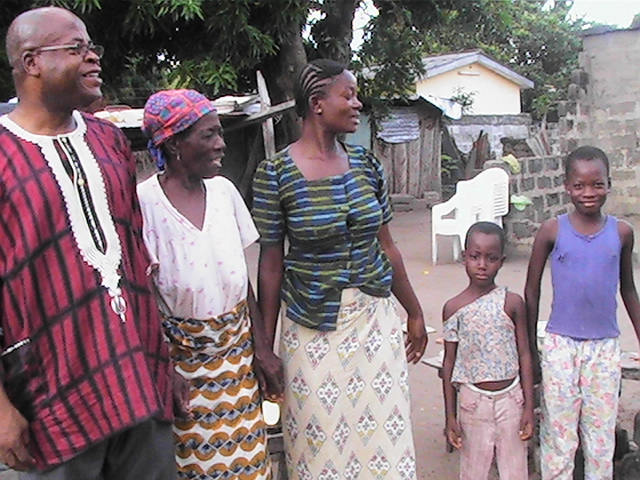

"It's Like A Miracle,"
... exclaims cousin Madam Desewu (center) at a meeting of the Tovie (toh-vee-uh) clan on Saturday, November 4, in the ancestral village at Tegbi. With her are Gideon Agbemabiese and her daughter, Agnes Ablayo Agbemabiese.

The American Cousin
Before heading out to the airport with my son, Amahl, I had the usual pre-trip butterflies I always seem to get before I leave for somewhere. It's about anticipating whatever lies ahead; it's about fretting over what I might have forgotten or left undone in the last minute rushing around. Organization is not my strong suit, so there's always last minute rushing around, no matter how carefully I try to plan. But these butterflies were of a whole other order. I was about to fulfill a dream I'd harbored since I was a kid - the dream of finding and meeting our long-missing kinfolk in Africa.

The older and riper a dream becomes, the higher are the stakes if the reality can never quite live up to all the hope and emotion you've invested in it. How would I be received? How should they receive someone whose ancestor went missing from their fold between two hundred ten and two hundred forty years ago? That's a very long time. And much, much water, as they say, has gone over the dam since then... on my side of the Atlantic, as well as theirs. So given that, how are they supposed to feel about me? And for my part, I've always harbored a big romance about how I would feel if I ever found them. But in a few hours time, there we'd be, face to face for the first time, for real. Would the gulf created by time and culture turn out to be too wide and too deep to breach? Or would that sense of connection I have so deeply desired rise up and become a tangible thing? Would I feel, in their presence, like I was home?

The trip to Amsterdam, my stopover destination, was not an auspicious beginning. It wasn't a disaster... just kind of drag, like a long flight can be when there's not much conversation to be had, despite all of us back there in coach jammed together like sardines. A sourness hung in all that dead coach cabin air that was so oppressive, I couldn't wait to get off that plane.

But once in line for the flight to Ghana, things got much better. Ghanaians happy to be going home were talking animatedly, and allowed me to float in and out of a half-dozen different conversations as the line slowly snaked its way through security. I talked to ex-pat African Americans on their way home, missionaries; African Americans, like me, on their first trip to Africa. Once on the plane the lively hub-bub of the airport gate became more like a party. Tired of the usual airline swill, I'd ordered the "Hindu Vegetarian" meal this time, and it was great.

Two and a half hours out of Amsterdam, our plane cleared the coast of southern France, and all of a sudden, the butterflies returned. I knew that the next major land mass I'd see below would be Africa.

But as we approached the African coast, our arrival was anti-climatic. Algeria was covered in dense clouds... and the moon was rising; dusk already rolling in. Then, just in time to enjoy the view for a while before darkness fell, the clouds parted and, from 35,000 feet we could finally gape at the almost unimaginable vastness of the Sahara. That first clear view was the only moment of silence during the entire trip. A Ghanaian stretching himself in the aisle leaned over to look out the window just ahead of mine. "Mama Africa," he said with a smile. I smiled too, grateful that this most pleasant flight had given me what I felt must be a little taste of being in Ghana already... like the experience of dangling your feet in the pool for a beat before slipping fully into the water.

Shortly after the plane landed to the sound of loud applause from the passengers in coach, that pool analogy turned out to be profoundly apt. Because within just a few hours, I'd find myself feeling like a kid tossed into the deep end of a pool - the deep, deep end of a very deep pool.
Come back and visit me at this blog in a few days and I promise, I'll explain.